Sushi Making Class Shinjuku Tokyo — 3-Hour Deep Dive with Cooking Sun

The sushi making class Shinjuku Tokyo by Cooking Sun is the longest, most varied sushi class on this page — three hours, four sushi styles, a Japanese rolled egg (tamagoyaki), miso soup, and a recipe pack to take home. The studio is in a quiet residential building in Shinanomachi (Shinjuku ward), run by a small team of friendly local instructors who cap the group at nine people to keep the session personal. With 4.9★ across 416 reviews and a strong record of accommodating gluten-free, vegetarian, allergy-related, and religious dietary needs, Cooking Sun is the right class if you want depth over speed — more time, more styles, and skills that actually translate to your kitchen at home.
About This Activity
Up to 24 hours in advance — full refund
Secure your spot with no payment today
3 hours
Shinanomachi 18-39, Shinjuku-ku, Tokyo — 2nd floor of a beige residential building; press 314 on the intercom
4.9★ from 416 verified reviews
All ingredients and utensils, recipes to take home, towel and apron rental
Gluten-free, vegetarian, allergy and religious dietary needs accommodated with advance notice
Check Live Availability
Maximum 9 participants. Cooking Sun's Shinjuku studio runs a full three-hour session — check dates and book your spot.
Why the Cooking Sun 3-Hour Class Covers More Ground Than Any Other Option
Most Tokyo sushi classes allocate 90 minutes to one or two styles. Cooking Sun's three-hour format covers four: nigiri, inari, hosomaki (thin roll), and California roll — plus tamagoyaki (Japanese rolled egg), which isn't sushi but is a foundational Japanese kitchen technique that often gets skipped in shorter classes.
The recipes you learn here are taught with a home kitchen in mind. Instructors Yuki, Miki, Aya, and Kanako explain why each ingredient behaves the way it does, not just what steps to follow. You'll understand how sushi rice changes in flavour and texture depending on the ratio of sushi-zu, and why inari pouches need to be lightly squeezed before filling. This is practical knowledge, not just demonstration.
The small group cap (nine people) means you get individual feedback throughout. Reviews consistently praise the personal atmosphere — several describe it as feeling more like cooking at a friend's house than attending a class. The studio is a genuine home kitchen in a residential Shinjuku building, which reinforces that feeling. Among all tokyo sushi making class options, this is the most thorough.
What You'll Make — Four Sushi Styles and Tamagoyaki
The three hours are structured as a progressive cooking lesson rather than a production line. You build from the foundations outward — rice first, then the simplest styles, then the more complex rolls.
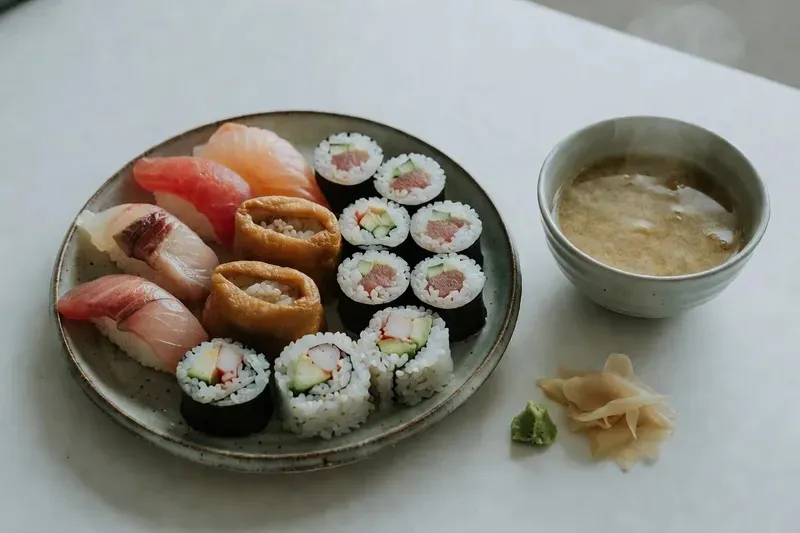
- Sushi rice from scratch: dashi stock introduction, the correct rice-to-water ratio, and how to fold in sushi-zu without breaking grains
- Miso soup: made alongside the rice — you understand the dashi base and traditional Japanese seasoning before sushi even begins
- Tamagoyaki: Japanese rolled egg made in a rectangular pan — the brushing, folding, and rolling technique that produces a layered, slightly sweet omelette
- Nigiri: hand-pressed oval rice with shrimp topping — learn the shaping pressure and finger technique
- Inari: rice packed into sweet tofu pouches — the lightly squeezed pouch and rice-filling ratio
- Hosomaki (thin roll): seaweed-wrapped single-filling roll — maki rolling with minimal filling
- California roll: nori, rice, avocado, cucumber, surimi — the outside-in roll assembled inverted on a bamboo mat
- Sit-down meal: eat everything at the table with fresh wasabi and pickled ginger
- Recipe pack: all recipes and techniques explained in English, printed and yours to keep
What's Included
- All ingredients: sushi rice, nori, shrimp, avocado, cucumber, surimi, tofu inari pouches, eggs, dashi stock
- All utensils: bamboo mat, rice paddle, tamagoyaki pan, knife
- Towel and apron rental for the class
- Recipe pack with all dishes — printed in English and taken home
- Miso soup and sit-down meal at the end with wasabi and pickled ginger
- English-speaking instructors throughout
Not included
- Hotel pickup or transportation to the studio
- Drinks (water provided; beverages available nearby)
How the 3-Hour Class Works
- Arrival: find the beige residential building at Shinanomachi 18-39 (use Google Maps: 'Cooking Sun Tokyo'); press 314 on the intercom; studio is on the 2nd floor
- Introduction: instructors explain Japanese ingredients — dashi, traditional seasonings, and the role of sushi-zu in rice preparation
- Miso soup: made first while the rice cooks — dashi base, seasoning, and serving
- Tamagoyaki: step-by-step folded egg omelette in a rectangular pan
- Sushi rice: seasoned and cooled correctly while you watch the technique
- Nigiri: hand-press shrimp nigiri with the chef correcting your shaping
- Inari: fill the tofu pouches with seasoned rice
- Thin roll and California roll: maki rolling technique — inside-out for the California roll
- Sit-down meal: eat your full plate with miso soup, fresh wasabi, and pickled ginger
- Recipe pack: receive your printed recipe cards at the close of the session
Important Things to Know Before You Go
The studio location is the main thing to prepare for:
- The studio is in a residential building — it looks like an apartment, not a restaurant. Use Google Maps with the search term 'Cooking Sun Tokyo' or the address Shinanomachi 18-39, Shinjuku-ku
- At the entrance you'll see two doors — use the RIGHT-SIDE door, which leads to the studio
- Press 314 on the intercom if the door is closed
- If arriving by private car: park in a nearby coin-operated lot; do not stop in front of the building to avoid disturbing neighbours
- Dietary requests (GF, vegetarian, religious, allergy) must be made at booking — the kitchen substitutes ingredients in advance and cannot accommodate same-day changes
- The class does not include instruction on cutting raw fish — pre-sliced fish is used throughout
Getting There — Shinanomachi, Shinjuku
Who This Class Is For
Cooking Sun's three-hour class suits anyone who wants more than a tasting — who wants to leave understanding how sushi is actually made, not just having made some.
- Travelers who want to cook Japanese food at home after the trip — the recipe pack makes this achievable
- Guests with dietary needs: Cooking Sun has a strong track record on gluten-free, vegetarian, allergy-related, and religious substitutions — better than any other class in this guide
- Small groups or families who prefer an intimate atmosphere over a large class
- Anyone with a genuine interest in Japanese culinary technique beyond sushi — tamagoyaki and miso soup are genuinely useful skills
- Guests staying in or near Shinjuku who want a class in the neighbourhood without a commute
Not suitable for
- Travelers with less than 3 hours available — the session cannot be shortened
- Guests who need instruction on raw fish cutting or filleting — the class uses pre-sliced fish throughout
Frequently Asked Questions
Why is the Cooking Sun studio hard to find?
The studio is on the 2nd floor of a quiet residential building in Shinanomachi — it's a genuine home kitchen, not a commercial venue. Search 'Cooking Sun Tokyo' in Google Maps and navigate to Shinanomachi 18-39, Shinjuku-ku. At the entrance, use the right-side door and press 314 on the intercom. Most reviewers who mention the location say it was straightforward once they used the maps link.
What is tamagoyaki and why is it taught in a sushi class?
Tamagoyaki (卵焼き) is a Japanese rolled omelette made in a rectangular pan — layers of lightly beaten egg, seasoned with dashi, soy sauce, and mirin, folded repeatedly as they cook to create a dense, layered result. It appears in sushi sets as a sweet egg nigiri topping (tamago sushi), and it's a foundational Japanese home-cooking technique. Most sushi classes skip it; Cooking Sun includes it because the three-hour format allows the time.
What is the maximum group size?
The class is capped at nine participants. This is the smallest group cap of any class in this guide, and it's why the atmosphere is consistently described as personal and relaxed in reviews.
Can I accommodate a gluten-free diet?
Yes — Cooking Sun has one of the strongest records for dietary accommodation in Tokyo. Gluten-free soy sauce (tamari) can be substituted, and instructors flag cross-contamination points. Multiple reviews specifically praise the gluten-free handling. The request must be made at booking.
What four types of sushi does the class cover?
Nigiri (hand-pressed with shrimp), inari (sweet tofu pouch), hosomaki (thin seaweed roll), and California roll (outside-in roll with avocado, cucumber, and surimi). Plus tamagoyaki and miso soup. The full menu is the broadest of any sushi class in Tokyo.
Do I get to keep the recipes?
Yes. At the end of the session, you receive a printed recipe pack covering all the dishes you made — in English, with measurements and technique notes. This is the only sushi class in this guide that includes a recipe takeaway.
Is the class suitable for solo travelers?
Yes — several reviewers specifically mention attending solo and enjoying the group dynamic. The home-kitchen atmosphere and small group size mean you're naturally part of the session rather than a stranger in a crowd.
How long does the class take?
Three hours exactly. The class does not offer a shorter version — if you have a tight schedule, the 90-minute Asakusa class or the Shibuya temaki class are better suited. Block out the full morning or afternoon.
How do I get there without a smartphone?
Download the Cooking Sun Tokyo map pin before you leave your hotel. The building is at Shinanomachi 18-39, Shinjuku-ku. Shinanomachi Station (JR Sobu Line) is 5 minutes on foot. If arriving by taxi, show the driver the address in Japanese: 新宿区信濃町18-39.
How does this compare to other sushi classes in Tokyo?
Cooking Sun is the longest class in duration, covers the widest variety of sushi styles, has the strongest dietary accommodation record, and provides the only take-home recipe pack. It's more expensive than the Shibuya class ($65 vs $45) but significantly more comprehensive. See the full side-by-side on our sushi making class in tokyo comparison page.
What Travelers Say
Definitely one of the highlights of my trip to Japan! There's no better place to learn how to make sushi. The teachers were incredibly friendly and professional, the small group size felt personal and relaxed, and I learned an impressive amount in one session. I left with a big smile and can't wait to try what I learned back home.
This was a really fun course and I found it to be very enriching. Aya and Miki were both very friendly and helpful. I urge anyone visiting Japan to take part in a sushi making class regardless of how good or bad your cookery skills are.
One of my favourite experiences in Tokyo! Kanako and Miki were excellent teachers and we made eight recipes. I appreciated that we could take home the recipes — I've already tried the tamagoyaki at home. Highly recommended.